
The cybersecurity industry is entering a phase where AI is no longer a feature, but an architectural dependency. AI-native security is no longer a nice-to-have.
However, much of the current analyst discourse still evaluates AI security tools through the lens of SOC efficiency, alert handling, or workflow automation. This framing underestimates where the highest long-term security value is emerging.
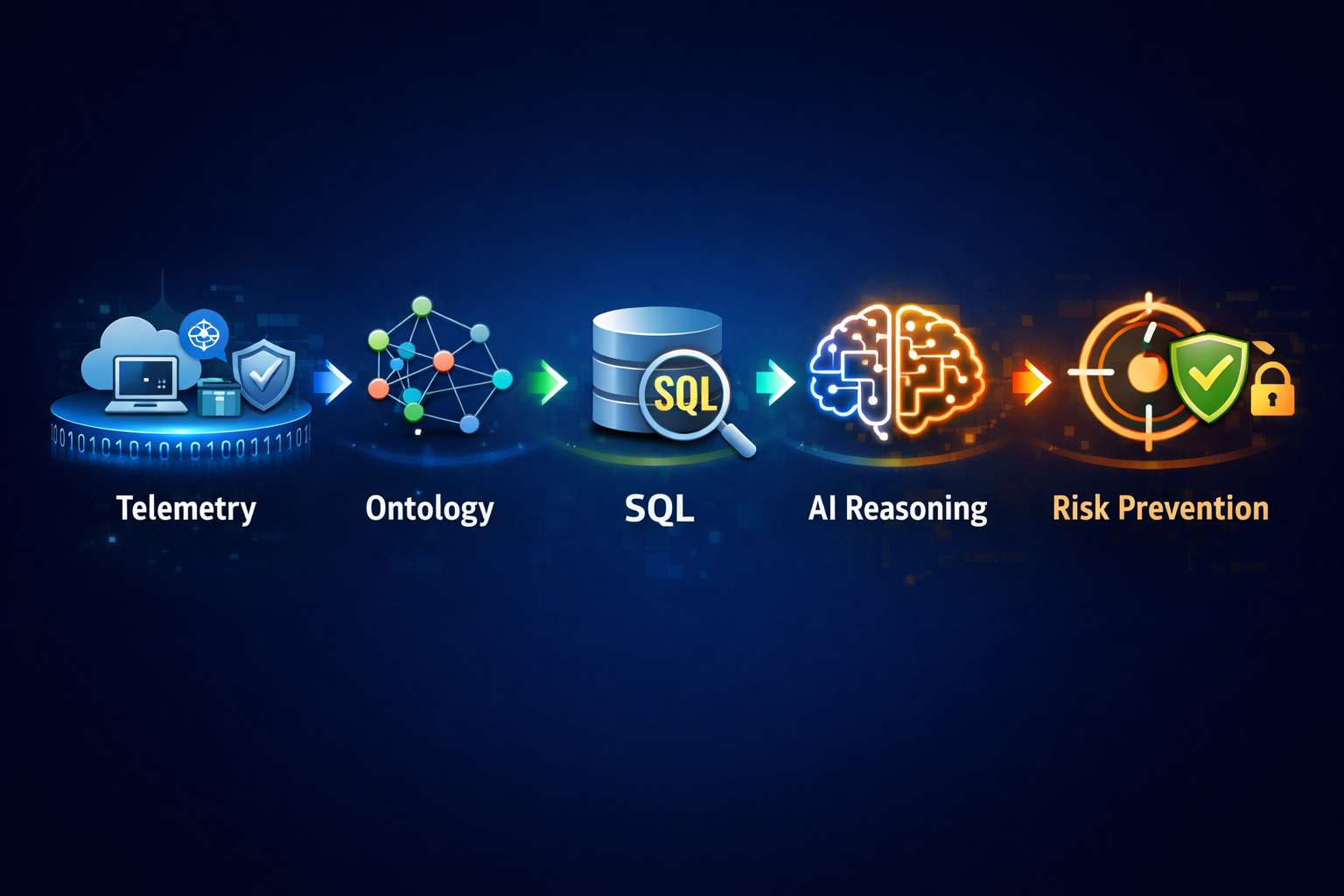
At Uptycs, our experience building and deploying Juno, an AI-native reasoning layer, suggests that the real inflection point is upstream risk reduction—made possible not by generic LLMs, but by AI operating on top of a purpose-built cybersecurity ontology that unifies cloud, endpoint, Kubernetes, container, and identity telemetry.
This note explains why ontology-driven AI reasoning is becoming essential, why it is difficult to communicate using legacy categories, and why it represents a fundamentally different class of AI security capability.
The core problem: AI without structure does not reduce risk
The industry has broadly accepted that:
- Attackers now operate at machine speed
- Threats are increasingly behavioral, identity-centric, and cross-domain
- Static rules and signatures are insufficient
What is less widely recognized is why many AI-based security tools still fail to reduce risk meaningfully.
The core issue is not model quality, it is lack of structured context.
Most AI security tools today operate on:
- Alerts
- Logs
- Events
- Natural-language descriptions of incidents
This data is unstructured or semi-structured, forcing AI to infer meaning probabilistically. The result is AI that is:
- Reactive rather than preventive
- Alert-dependent
- Constrained to downstream workflows
This is why many AI tools excel at summarization or triage but struggle with causal reasoning, attack path inference, or proactive risk reduction.
Why upstream risk reduction requires a security ontology
What we mean by a cybersecurity ontology
At Uptycs, we use “ontology” in a precise sense—not as a marketing term.
A cybersecurity ontology is:
- A formal, machine-readable model of entities and relationships
- Spanning endpoint, cloud, Kubernetes, containers, and identity
- Encoding how assets, identities, permissions, processes, and workloads relate over time
Examples of ontology relationships:
- Which identities can assume which roles
- Which processes executed inside which containers
- Which workloads communicate across cloud boundaries
- Which permissions enable lateral movement paths
This ontology is continuously updated, not static.
Why ontology matters for AI reasoning
AI models reason best when:
- Entities are explicitly defined
- Relationships are deterministic
- Constraints are queryable
- Context is preserved across domains
By operating Juno on top of a security ontology, Uptycs enables AI to:
- Ask precise questions about environment state
- Traverse relationships instead of correlating alerts
- Understand why behavior is risky, not just that it is anomalous
- Detect attack paths that never trigger signatures or alerts
This is fundamentally different from feeding logs into an LLM.
The role of SQL: why this matters more than prompts
A key challenge in communicating Juno’s value is that SQL is not usually associated with AI innovation, yet it is central to making AI effective in cybersecurity.
SQL as a reasoning accelerator
In Uptycs:
- The ontology is queryable using SQL
- AI reasoning is grounded in deterministic queries
- LLMs are used to reason over query results, not raw data
This architecture allows Juno to:
- Reduce hallucination risk
- Validate AI conclusions against ground truth
- Move from probabilistic inference to bounded reasoning
- Scale reasoning across millions of assets without token explosion
In effect, SQL acts as a cognitive amplifier for AI, allowing it to reason faster, more accurately, and with far less ambiguity.
This is one of the most misunderstood—but most important—design choices in AI-native security platforms.
Why this enables upstream risk reduction (not just faster response)
Because Juno reasons over a unified ontology:
- It detects pre-attack conditions, not just active incidents
- It identifies latent risk exposure (identity misuse, cloud misconfiguration, privilege chains)
- It surfaces issues that would never become alerts in traditional systems
This allows security teams to:
- Reduce attack surface before exploitation
- Collapse attacker dwell time by preventing viable paths
- Prioritize remediation based on actual exploitability, not severity scores
This is what we mean by upstream risk reduction.
Why SOC-centric AI models fall short (structurally)
SOC-agent and copilot tools typically:
- Depend on alerts generated elsewhere
- Operate after detection
- Optimize human workflows
They provide real operational value, but:
- They do not change the underlying risk model
- They cannot reason across domains without a shared ontology
- They struggle to identify risks that do not manifest as incidents
From an architectural standpoint, they are downstream consumers of security intelligence, not producers of it.
Why analysts struggle to categorize ontology-driven AI (and why that must change)
One reason this is hard to communicate is that current analyst categories are misaligned:
- “AI security” often implies SOC automation
- “CNAPP” focuses on cloud posture, not reasoning
- “XDR” emphasizes detection, not causality
Ontology-driven AI reasoning does not fit neatly into these buckets.
Yet, as AI-driven attacks become more autonomous and cross-domain, this architecture becomes necessary, not optional.
A proposed analyst framing shift
We believe analysts should begin distinguishing between:
1. AI-assisted security tools
- AI improves speed, summarization, triage
- Dependent on alerts and workflows
- Primarily downstream value
2. AI-native security platforms
- AI is embedded into the control plane
- Reasoning is ontology-driven
- Value comes from risk prevention and structural insight
Juno is designed for the second category.
Closing thought
AI in cybersecurity is not a race to build the smartest model.
It is a race to build the most complete, structured, and queryable understanding of the environment, and then apply AI reasoning on top of it.
Uptycs’ security ontology, combined with SQL-accelerated AI reasoning through Juno, represents an architectural approach explicitly designed for AI-era threats, not SOC-era workflows.
We believe this distinction will increasingly define how the market and analysts separate durable security platforms from short-term AI augmentation.